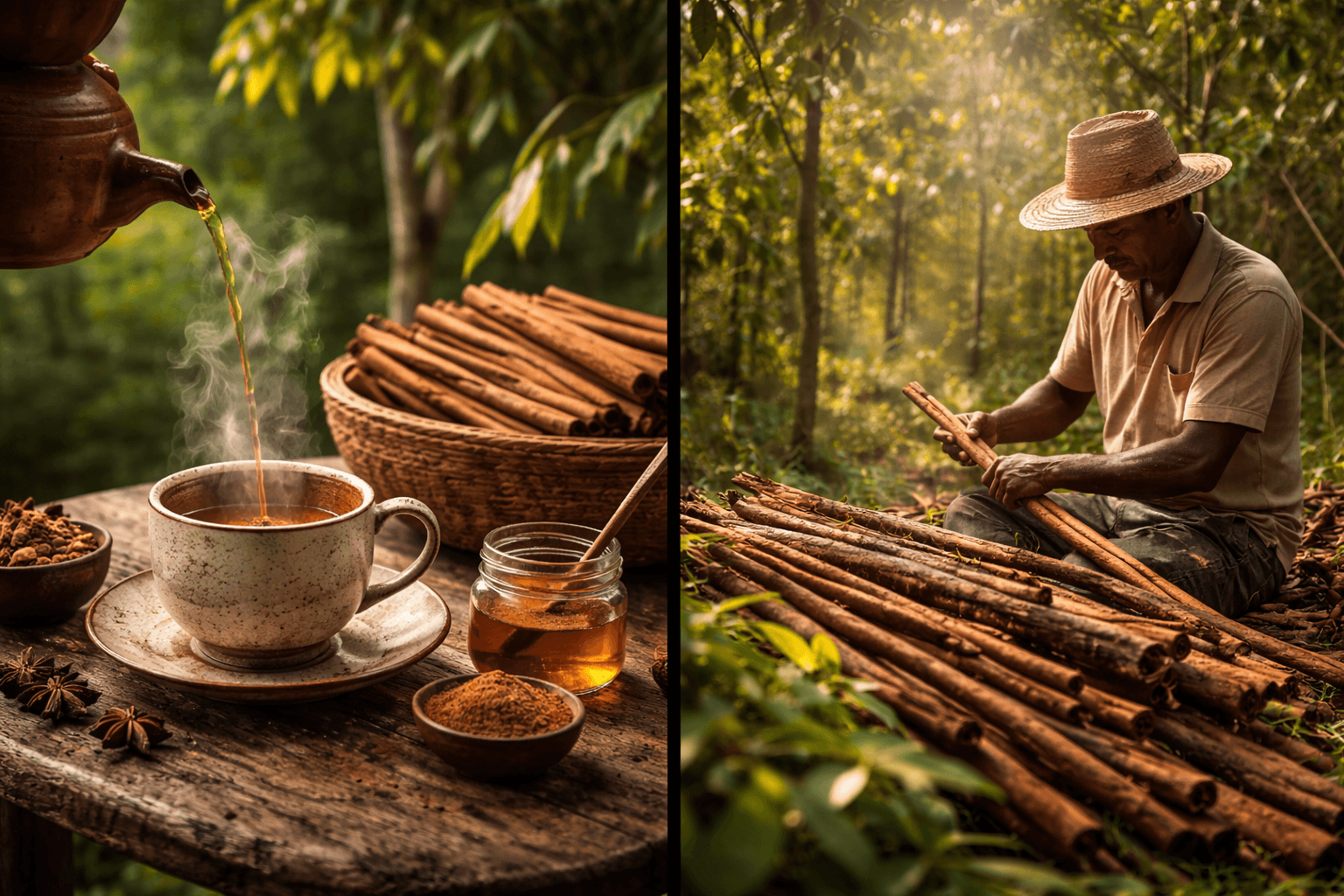
For centuries, cinnamon was not a flavoring. It was a functional botanical, prized in royal kitchens, traditional medicine, and daily nourishment. What most people consume today under the name “cinnamon” is something else entirely. The distinction matters—especially for those who use cinnamon regularly, intentionally, and as part of a natural lifestyle.
The Cinnamon Most People Know Is Not True Cinnamon
There are two fundamentally different species sold as “cinnamon” on the global market: Cinnamomum Verum (True Ceylon Cinnamon—the original) and Cassia varieties (Chinese, Indonesian, or Saigon—the imposters). They are not interchangeable.
Cassia dominates modern markets for industrial reasons: it is faster-growing, thicker-barked, cheaper to harvest, and aggressive in flavor. True cinnamon was historically rare—and remains so today.
The Chemistry of Daily Use
Why was Ceylon cinnamon traditionally preferred by ancient cultures? The answer lies in its structure. Cinnamomum Verum is naturally softer, more aromatic, and critically, lower in Coumarin.
The Coumarin Factor: Cassia varieties contain significantly higher levels of coumarin—a compound that, when consumed frequently, burdens the liver. Ceylon cinnamon contains only trace amounts. For cultures that consumed cinnamon daily, this distinction was not just culinary; it was toxicological. Ceylon cinnamon allows for consistent, long-term consumption without the physiological load.
A Gentler Metabolic Interaction: Emerging research suggests that true cinnamon interacts more gently with the body. It supports balanced insulin sensitivity, integrates seamlessly into blood sugar-conscious routines, and is suited for the “long game” of wellness, not just a momentary spike of flavor.
Refinement vs. Force
Cassia delivers impact through force. True cinnamon delivers depth through refinement. In a modern diet dominated by sharp sugars and artificial additives, our palates have been trained to expect “shouting.” Cassia is sharp, oily, and one-dimensional.
Once the body adjusts to True Cinnamon, however, the difference becomes unmistakable. It releases aroma gradually. It does not overwhelm the palate. It is a quiet return to what worked.
The Simply Ceylon Standard
We do not blend species. We do not substitute origins. We do not dilute profiles for yield. House of Cinnamon exists to restore this botanical to its rightful role—not as a commodity, but as a considered ingredient. Every product we offer is sourced from Sri Lanka, cultivated under conditions that cannot be replicated elsewhere.
This is not trend-driven sourcing. It is continuity. True cinnamon was never meant to be loud. It was meant to last.
Clinical Footnotes
01. Coumarin Content & Safety — The German Federal Institute for Risk Assessment (BfR) highlights that Cassia cinnamon contains significantly higher levels of coumarin, while Ceylon cinnamon contains only trace amounts.
02. Botanical Distinction — The National Center for Biotechnology Information (NCBI) confirms that Cinnamomum Verum is botanically distinct with a different phytochemical profile than Cassia.
03. Metabolic Interaction — Studies reviewed by diabetes-focused institutions note that cinnamon species play a role in insulin signaling pathways when used in dietary contexts.
The information presented is for educational purposes only and is not intended to diagnose, treat, cure, or prevent any disease. Always consult a qualified professional regarding dietary choices.