We accept without question that a Pinot Noir from Burgundy tastes different than one from California. Yet, when it comes to cinnamon, the world has accepted a flattening of the map.
Wine has terroir. Coffee has terroir. Chocolate has terroir. Cinnamon is no different—the industry simply chose to erase it.
Like any botanical, Cinnamomum Verum is a mirror of its environment. The chemical composition of the bark is dictated by the iron content of the soil, the humidity of the Indian Ocean breeze, and the altitude of the harvest.
The Estate Signatures
Sri Lanka is not a monolith. It is an island of distinct micro-climates. At House of Cinnamon, we refuse to blend across these regions. We isolate them, allowing the specific character of the land to speak.
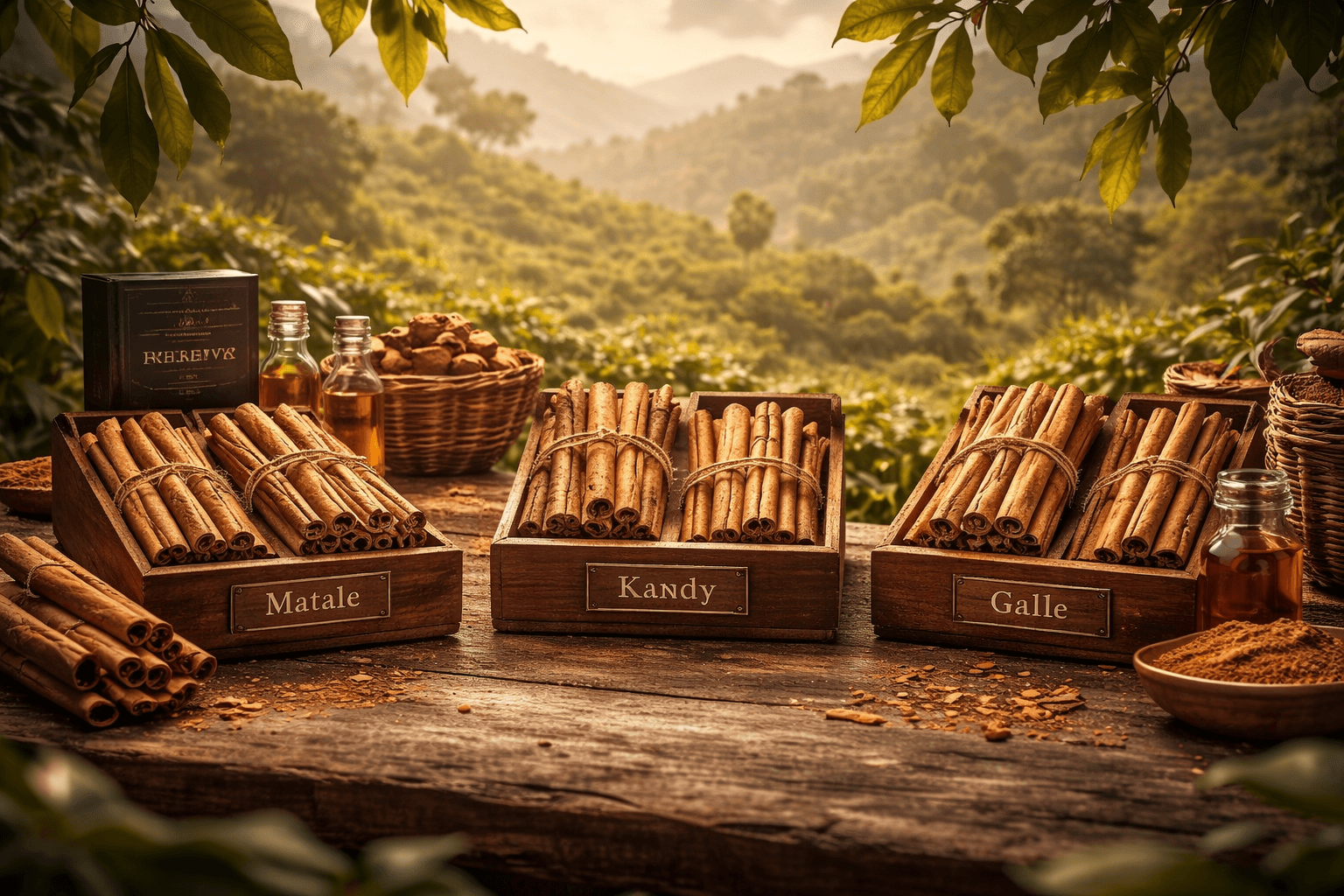
Estate | Matale (The Classic) — Warm, structured, and harmonized. Located in the central hills, Matale offers a balance of rainfall and heat. This produces a spice that is the definition of “equilibrium”—soft sweetness rounded by a confident, woody spice. It is the reference point for true Ceylon.
Estate | Kandy (The Highland) — Bright, floral, and aromatic. The higher elevation brings cooler nights and misty mornings. This stresses the tree slightly, forcing it to produce more complex, volatile aromatics. The result is a “lifted” flavor profile—lighter on the tongue, with distinct notes of flower and citrus.
Estate | Galle (The Coastal) — Rich, sweet, and sun-drenched. Bathed in the humidity of the southern coast and rooted in sandy soils, Galle cinnamon is known for its depth. It lacks the “bite” of the highlands, offering instead a deep, sugary warmth that feels grounded and heavy.
The Erasure of Blending
In the commercial spice trade, consistency is valued over character. Large exporters blend harvests from Matale, Kandy, and Galle into a single batch to create a uniform product. This is the destruction of meaning.
When cinnamon is blended, traceability is lost. Research becomes impossible. You are no longer tasting a specific harvest; you are tasting an industrial average.
Estate-specific sourcing is the only path to comparative study, genuine refinement—allowing chefs to pair specific estates with specific dishes—and transparent quality.
Alba Reserve: The Threshold
While our Estate Collections are defined by geography, Alba Reserve is defined by a standard. Alba is not a region. It is a moment of perfection. It exists only when multiple conditions align: exceptional bark thinness, ideal oil composition, and structural integrity. It is the “Grand Cru” of the harvest—a selection that represents less than 1% of the total yield.
It is tied to a threshold. When that threshold is not met, the Alba collection is not released.
A Research-Ready Foundation
Understanding the future of cinnamon—whether for culinary mastery or therapeutic use—requires inputs that are pure. Real research cannot be built on generic, blended material.
House of Cinnamon is not just a product line. It is a research-ready foundation. We provide the pure species, the known origin, and the controlled processing required to rediscover the true potential of the world’s most misunderstood spice.