Cinnamon is one of humanity’s oldest obsessions. Long before it became a staple of kitchens and confections, this fragrant bark shaped trade routes, ritual practices, medicine, and myth. It was worth its weight in silver. It traveled farther than most people ever would. It perfumed temples, preserved kings, and scented the idea of luxury itself.
For millennia, cinnamon was not merely consumed—it was revered. And yet, despite its familiarity, most people today have never truly encountered it.
A Spice That Defined Civilizations
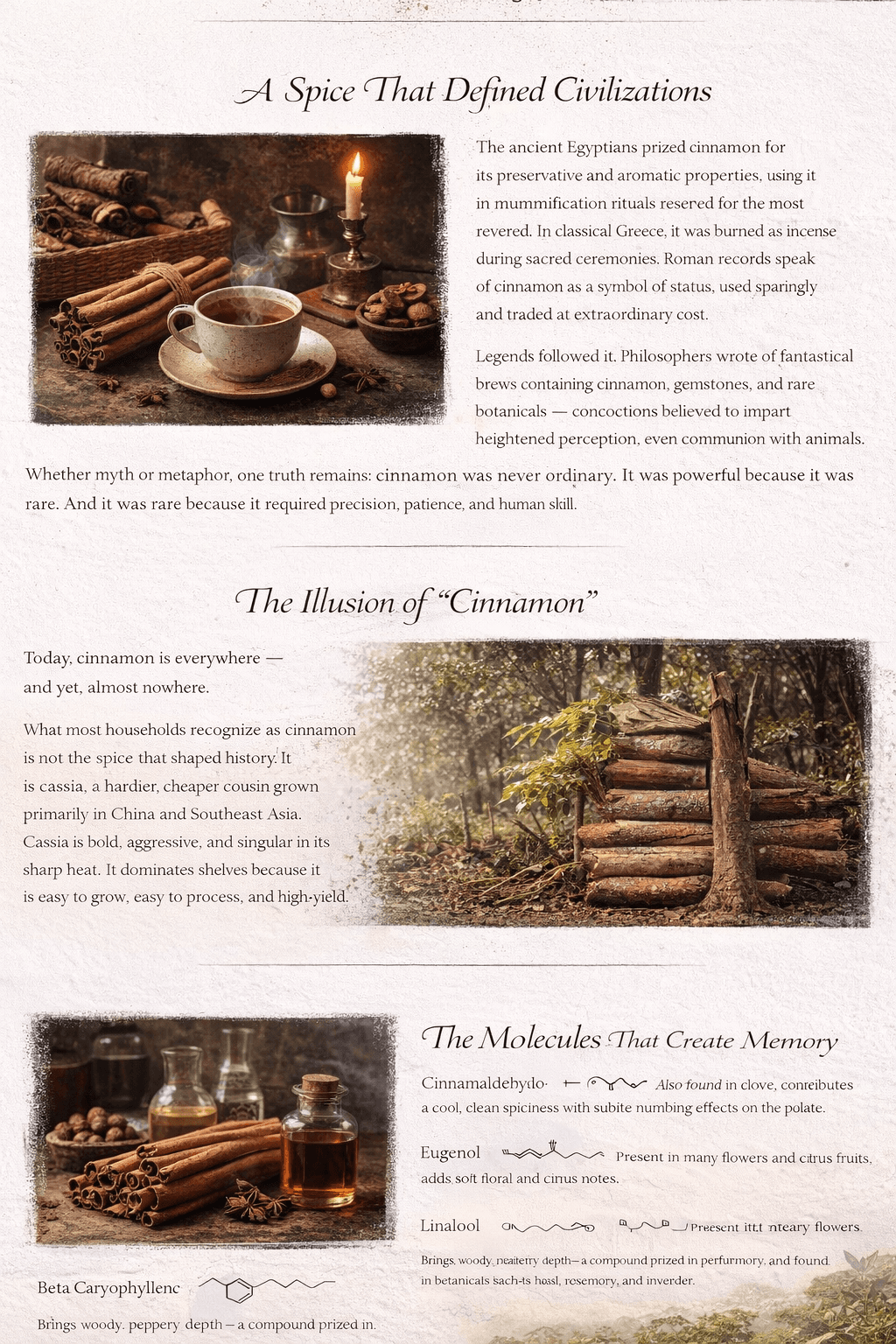
The ancient Egyptians prized cinnamon for its preservative and aromatic properties, using it in mummification rituals reserved for the most revered. In classical Greece, it was burned as incense during sacred ceremonies. Roman records speak of cinnamon as a symbol of status, used sparingly and traded at extraordinary cost.
Legends followed it. Philosophers wrote of fantastical brews containing cinnamon, gemstones, and rare botanicals—concoctions believed to impart heightened perception, even communion with animals. Whether myth or metaphor, one truth remains: cinnamon was never ordinary.
It was powerful because it was rare. And it was rare because it required precision, patience, and human skill.
The Illusion of “Cinnamon”
Today, cinnamon is everywhere—and yet, almost nowhere. What most households recognize as cinnamon is not the spice that shaped history. It is cassia, a hardier, cheaper cousin grown primarily in China and Southeast Asia. Cassia is bold, aggressive, and singular in its sharp heat. It dominates shelves because it is easy to grow, easy to process, and high-yield.
True cinnamon—Cinnamomum verum—is something else entirely. Native to Sri Lanka, Ceylon cinnamon is softer, lighter, and vastly more complex. Its aroma carries warmth without harshness, sweetness without sugar, spice without aggression. Floral facets emerge. Citrus whispers appear and fade. It does not shout. It reveals itself slowly.
Inside the Tree
Cinnamon is not a uniform ingredient. It is a botanical spectrum. Within a single cinnamon tree, different sections of bark yield entirely different aromatic qualities. The inner bark—thin, delicate, and pale—is the most prized. It carries the highest concentration of refined aromatic compounds and the least bitterness.
At Simply Ceylon, bark is selected, not harvested indiscriminately. We do not blend grades. We do not dilute origin. Every cut reflects a conscious decision—favouring nuance over volume, integrity over yield.
The Molecules That Create Memory
Cinnamon’s power lies not only in history or craft, but in chemistry. Its signature warmth comes primarily from cinnamaldehyde, an aromatic aldehyde that bonds easily with olfactory receptors.
Eugenol, also found in clove, contributes a cool, clean spiciness with subtle numbing effects on the palate. Linalool, present in many flowers and citrus fruits, adds soft floral and citrus notes. β-Caryophyllene brings woody, peppery depth—a compound prized in perfumery and found in botanicals such as basil, rosemary, and lavender.
True cinnamon is not loud. It is layered.
The Human Craft
True cinnamon does not exist without human hands. In Sri Lanka, cinnamon peeling is a specialized profession passed down through generations. Peelers work with remarkable precision, their hands stained permanently by the oils of the bark. The process is exacting: leaves plucked, outer bark scraped away, inner bark softened and beaten with brass, then sliced carefully using a small curved blade known as a kokaththa.
The bark is removed in long, delicate strips and rolled by hand into fine layers. As it dries, it transforms—pale ivory giving way to the warm brown recognized around the world. This is not extraction. It is craftsmanship.
Why It Still Matters
Cinnamon has endured because it engages all senses at once—taste, scent, memory, and emotion. It is both ancient and immediate. Familiar and elusive.
At Simply Ceylon, we exist to return cinnamon to its rightful identity—not as a commodity, but as a cultural, botanical, and aromatic treasure. True cinnamon is not meant to dominate. It is meant to be understood. And once understood, it is impossible to forget.