Cinnamon is not a powder. It is a living chemistry that begins dying the moment it is cut.
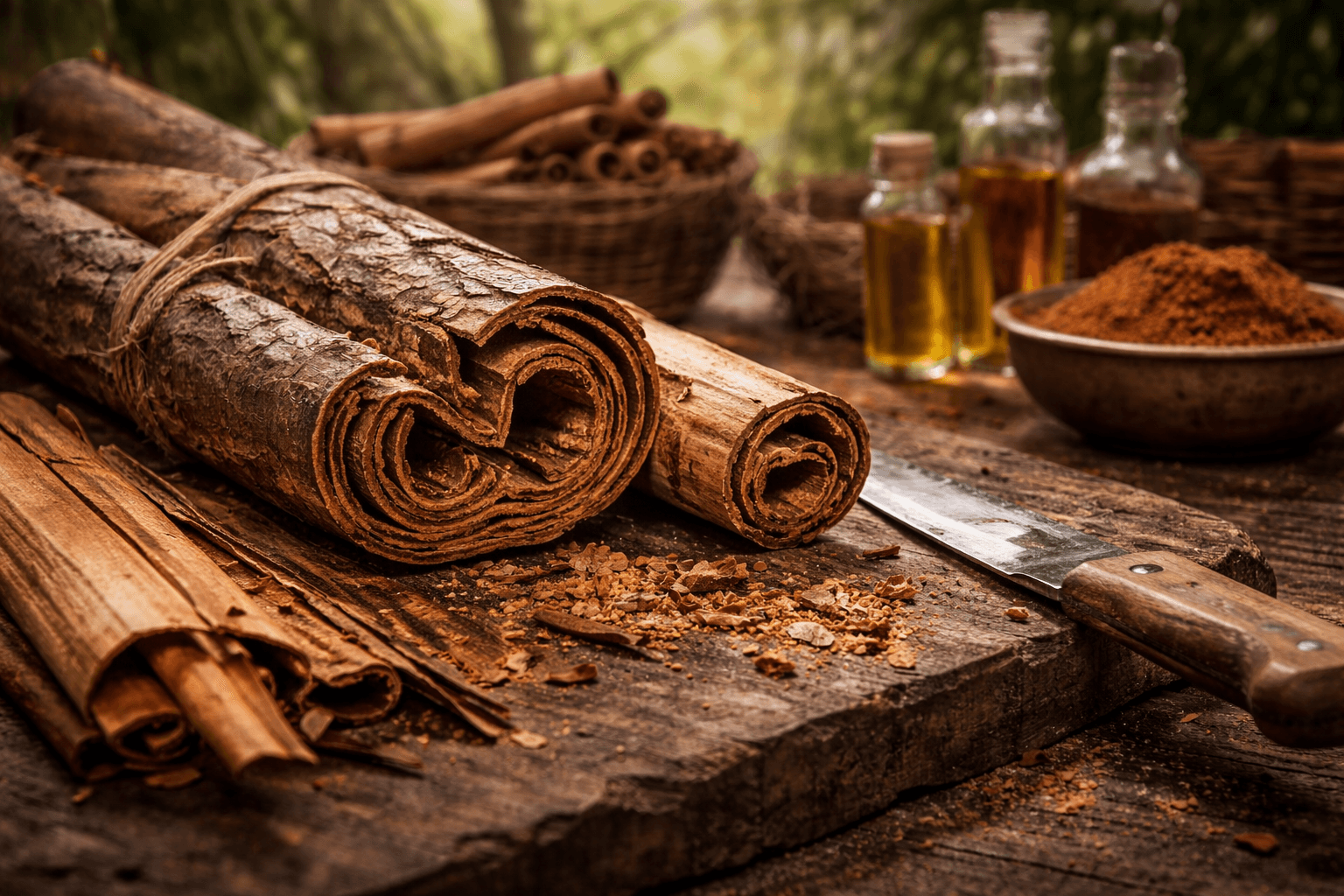
To understand true quality, one must first understand the anatomy of the tree. Cinnamomum Verum is not merely wood; it is a vessel for volatile essential oils. These oils—rich in cinnamaldehyde and eugenol—are the soul of the spice.
But nature is cruel. From the precise second the inner bark is severed from the shoot, a silent countdown begins. Time becomes the enemy. Oxidation sets in. Volatile compounds seek to dissipate into the air. The complexity of the aroma begins to flatten. The difference between “culinary gold” and “dust” is often determined in the first 72 hours of life.
The Industrial Compromise
In the vast machinery of the global spice trade, volume dictates method. The industrial process is a series of traumas inflicted upon the ingredient:
The Wait: Bark is piled in bulk, often waiting days for processing, allowing fermentation and degradation to begin. The Heat: Mechanical drying speeds up production but “cooks” the delicate top notes of the oil. The Exposure: Grinding happens months later in open-air facilities, where oxygen strips away the remaining potency.
The result is a spice that must be “corrected” with volume—you use more of it to taste anything at all.
“Industrial cinnamon shouts because it has forgotten how to whisper. True cinnamon retains the nuance of the living tree.”
The Simply Ceylon Process
Hand-Peeling: Master peelers remove the outer cork without damaging the oil-rich inner layer. The Quill: The fresh bark is hand-rolled immediately to trap the volatile oils inside the layers. Shadow Drying: We cure the quills slowly, away from direct sunlight, preserving the amber color and the therapeutic chemistry.
Liquid Truth: Why Oils Don’t Lie
Distillation is the ultimate lie detector. You can mask a poor quality powder, but you cannot mask a poor quality oil. Leaf and bark oils are the most honest expressions of the estate. If the material is stressed, old, or mixed, the oil will be cloudy and harsh. High-grade Verum yields an oil that is crystalline, chemically balanced, and aromatically precise.
It is why we treat our oils not as byproducts, but as the foundation of our collection.
The Tragedy of Powder
Powder is cinnamon’s most vulnerable form. It is where 90% of the world’s quality is lost. Mass-market powder is essentially sawdust—aged, overheated during grinding, and oxidized long before it reaches a jar.
The Simply Ceylon Standard is different. We mill at low temperatures to prevent “burning” the oils. The result is a powder that feels different to the touch: a pale, tan-gold color (not reddish-brown), soft and almost creamy on the palate, and naturally sweet, requiring no sugar to bring out the flavor.
A Philosophy of Restraint
Every component in a House of Cinnamon collection is handled with one rule: Processing should preserve, not amplify. We do not use artificial intensification. We do not use flavor correction. We rely on time-honored restraint. We allow the tree to speak for itself.