The spice aisle is a place of silent deception. What you have been told is cinnamon is likely nothing of the sort.
Walk into any purveyor of goods, from the local grocer to the industrial bakery, and you will see the label: “Cinnamon.” It is ubiquitous. It is familiar. And, in the vast majority of cases, it is a botanical lie.
We live in an era where the generic has replaced the genuine. But to understand what has been lost, one must first understand what was once possessed.
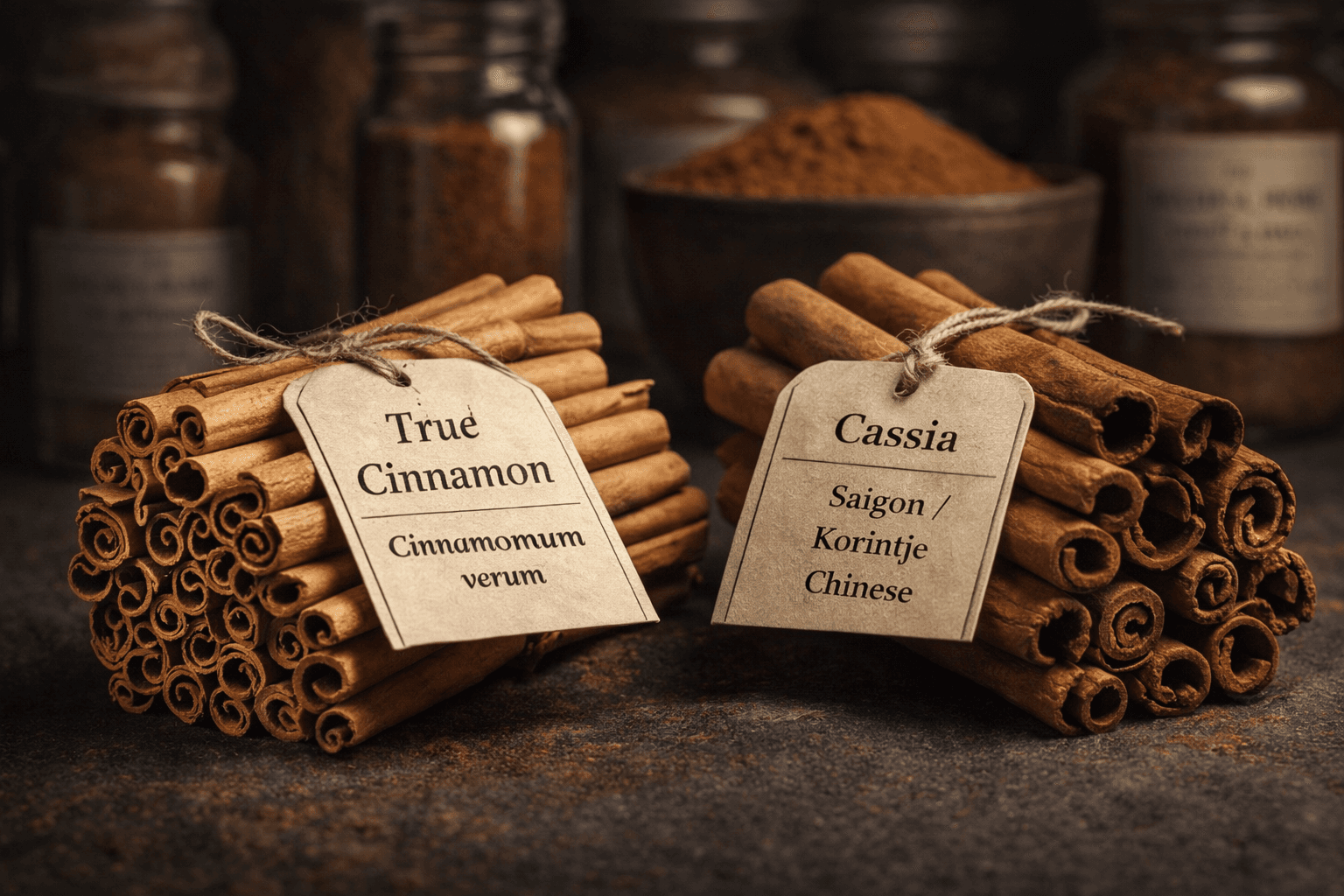
True cinnamon has a name: Cinnamomum Verum. It has a singular home: Sri Lanka. Everything else—the harsh Cassia of China, the spicy bark of Saigon, the thick quills of Indonesia—belongs to a different botanical family entirely. They are imposters, masquerading under a simplified label that hides a profound difference in chemistry, history, and soul.
The Victory of Commerce Over Character
How did we lose the truth? It was a quiet shift, driven not by the palate, but by the ledger.
As global trade industrialized, the demand for spice outpaced the delicate, labor-intensive harvest of true Ceylon cinnamon. The market looked for alternatives and found Cinnamomum cassia. It was coarser, harder, and significantly cheaper to harvest. It grew aggressively and yielded high volumes of thick, durable bark.
In the eyes of mass production, intensity replaced nuance. Yield replaced craft. Slowly, the definition of cinnamon was broadened to include these rougher cousins. The world’s palate adjusted to the sharp, spicy “burn” of Cassia, forgetting the soft, floral complexity of the true quill.
The Chemistry of Distinction
Cassia (The Imposter): Defined by a singular, blunt note of cinnamaldehyde. It is physically hard, requiring mechanical grinders to pulverize. More concerningly, it contains high levels of coumarin—a naturally occurring compound that is toxic to the liver in sustained doses.
Verum (The True): Defined by a complex architecture of flavor—notes of citrus, clove, and honey lie beneath the warmth. It is fragile, composed of paper-thin layers of inner bark hand-rolled by artisans. Chemically, it contains negligible traces of coumarin, making it the only cinnamon suitable for daily wellness and therapeutic use.
A Return to Sovereignty
For centuries, when kings and healers spoke of cinnamon, they spoke of Verum. It was the spice that anointed the Pharaohs and flavored the wines of Rome. They did not settle for the substitute.
When cinnamon became generic, we lost more than just a flavor profile. We lost the terroir of the Sri Lankan hills. We lost the distinction of the estate. We lost the connection to the craft.
Simply Ceylon exists to reverse this erasure. We do not view cinnamon as a commodity. We view it as an inheritance. House of Cinnamon was founded on a philosophy of absolute clarity: no substitutions, no blends, no simplification. We present the spice as it was meant to be experienced—by estate, by grade, and by harvest.
There is only one true cinnamon. It is time we called it by its name.